Structural heat distribution terminates bed bugs by denaturing their cellular proteins once core ambient temperatures maintain a range between 122°F and 135°F. The U.S. Our team confirms that…
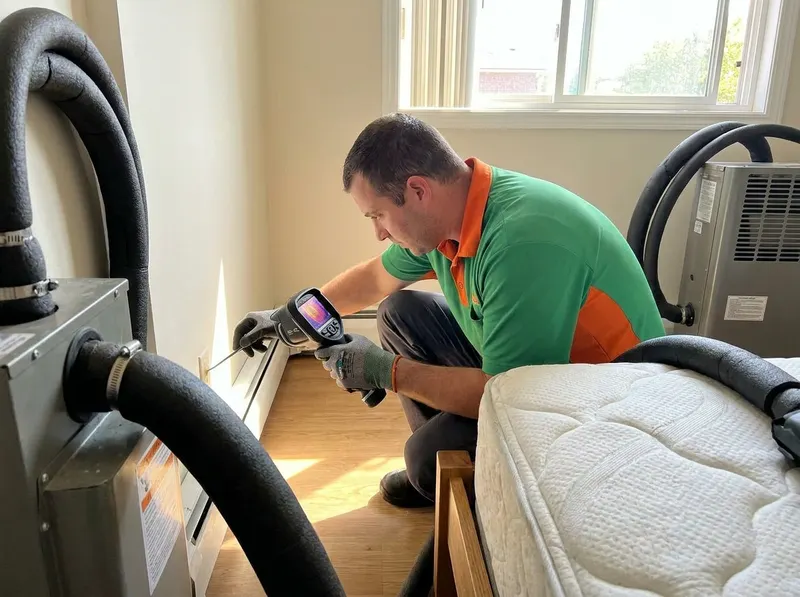
Structural heat distribution terminates bed bugs by denaturing their cellular proteins once core ambient temperatures maintain a range between 122°F and 135°F. The U.S. Environmental Protection Agency confirms that thermal remediation successfully penetrates mattress seams, hollow headboards, and wall voids where conventional liquid insecticides frequently fail due to documented pyrethroid resistance. The methodology engineered by PineRidge Pest Patrol pairs controlled industrial electric or indirect-fired heaters with monitored high-velocity air movers. This dynamic convection envelope forces lethal temperatures into insulated crevices, flooring sublayers, and architectural millwork across historic properties in Germantown and Belmont-Hillsboro without saturating living spaces in persistent chemical aromas.
Material safety requires meticulous ambient monitoring throughout the multi-hour dwell cycle. Technicians place calibrated wireless thermal sensors inside furniture cushions, closets, and baseline wall joints to verify uniform thermal soak across structural materials before cooling cycles begin. Standards recognized by the Pest Control Technology technical library emphasize that precision chemical barriers applied along room thresholds prevent bed bug migration into unaffected zones during the initial heat ramp. This integrated approach aligns with protocols detailed by the National Pest Management Association, ensuring that heat targets vulnerable harboring zones while non-volatile botanical or synthetic micro-residuals safeguard baseboard voids against external reintroduction.
Decision guidance dictates thermal remediation for immediate, comprehensive eradication when active infestations span multiple rooms or heavily upholstered areas. If an infestation remains isolated to a single hard-surface furnishing, physical vacuum extraction paired with low-toxicity desiccant dusts, such as amorphous silica gels evaluated by the University of Tennessee Extension, offers a targeted mechanical alternative. However, the operational trade-off centers on turnaround and personal labor: chemical and desiccant methods require multiple technician visits over 30 to 60 days, whereas convection heat treatment resolves mature populations and microscopic eggs in a single 8-hour deployment. PineRidge Pest Patrol delivers direct remediation without locking Nashville homeowners into arbitrary 12-month maintenance contracts.
Pre-treatment preparation preserves delicate household belongings while optimizing air movement. Residents in high-density multi-family structures in The Nations, Sylvan Park, or East Nashville must relocate aerosol cans, musical instruments, heat-sensitive candles, prescription medications, and oil paintings prior to system activation. Home structural preparation directives governed by Tennessee Department of Agriculture regulatory standards mandate distinct safety clearances around high-output air ducts. For detached properties near Radnor Lake State Natural Area or Woodbine, crawl space entries and subfloor registers are systematically sealed to preserve thermal momentum inside the living envelope, guaranteeing continuous exposure that completely penetrates thick hardwood flooring and masonry transitions.
Every job gets a firm, written price after a free on-site visit.
For standards, safe disposal, and service guidance on pest control services in Nashville, TN, useful references include U.S. EPA, ENERGY STAR, U.S. Dept. of Energy, Consumer.gov, U.S. Census Bureau, and Google Maps. General consumer and small-business resources are available from USA.gov, Better Business Bureau, FTC Consumer Advice, U.S. Small Business Administration, and Ready.gov.
Tell us about your bed bug thermal and precision remediation job in Nashville and we'll send a clear, written quote, usually the same day.
 PineRidge Pest Patrol